Car Will Not Start
No response, clicking, slow cranking, or an engine that cranks but will not start can involve the battery, starter, charging system, electrical connections, ignition, fuel delivery, sensors, or another system.
Warning light on, car running differently, or something just doesn’t feel right?
When the cause of a vehicle problem is unclear, a car diagnostic can help narrow down what is happening before parts are replaced.
Starting problems, electrical issues, rough running, warning lights, unusual sounds, and other symptoms can have several possible causes. Testing should follow the symptoms rather than beginning with a guessed repair.
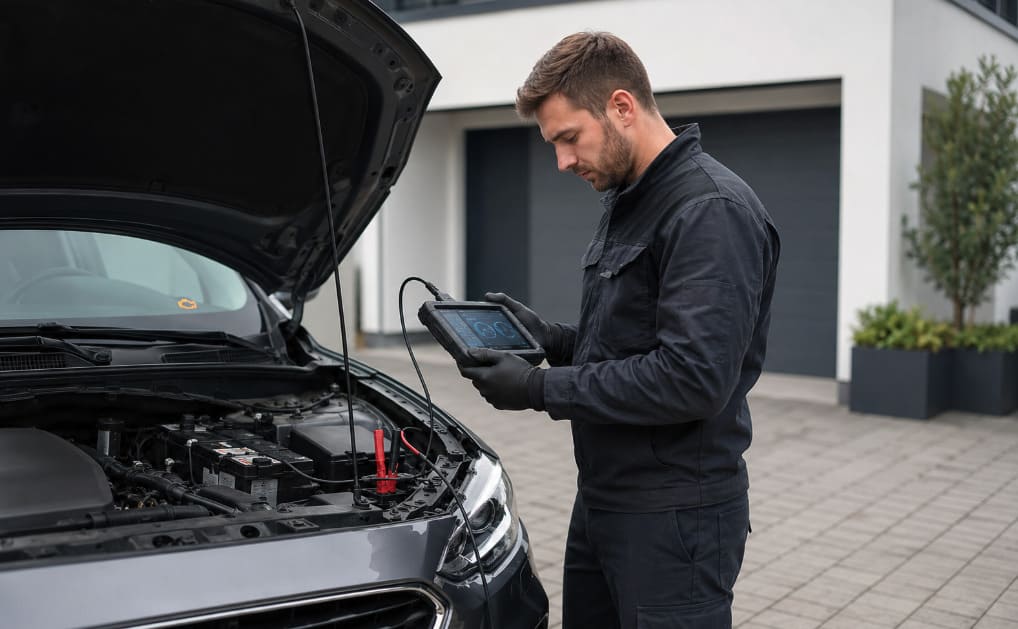
Diagnostics are most useful when the vehicle has a symptom but the failed component has not been identified.
No response, clicking, slow cranking, or an engine that cranks but will not start can involve the battery, starter, charging system, electrical connections, ignition, fuel delivery, sensors, or another system.
A check engine light means the vehicle has detected a fault, but the warning light does not identify the failed part by itself. Stored codes, scan information, symptoms, and testing may all matter.
Battery drain, intermittent power, accessories not working, unusual warning lights, charging concerns, or inconsistent starting may require electrical testing.
Misfires, shaking, poor idle, hesitation, stalling, or changes in performance can involve ignition, fuel delivery, sensors, airflow, electrical circuits, or engine controls.
Clicking, squealing, grinding, rattling, or another unfamiliar sound may help identify which system needs inspection, but the sound alone does not identify the failed component.
Sometimes the vehicle simply behaves differently and there is no obvious repair to request. Describe what the vehicle is doing rather than choosing a replacement part first.
The exact testing depends on the vehicle and reported symptoms. The diagnostic process should follow the evidence rather than starting with an assumed failed part.
Similar symptoms can come from very different failures. A weak battery can resemble a starter problem. A charging issue can leave a good battery discharged. A misfire may involve ignition, fuel delivery, wiring, sensors, or mechanical conditions.
A diagnostic trouble code is also a starting point, not always a final answer. Wiring, connectors, power and ground circuits, related sensors, mechanical conditions, or another system may still need testing.
For a starting-specific concern, see Car Won’t Start. For a check-engine-light-specific concern, see Check Engine Light Diagnostics.
Testing follows the reported symptoms and compares codes, measurements, scan information, visual findings, and vehicle behavior before recommending a repair.
Provide the vehicle year, make, model, service location, whether the vehicle starts, warning lights, unusual sounds, rough running, stalling, loss of power, electrical problems, and when the symptom occurs.
Depending on the problem, testing may include scan-tool checks, electrical measurements, battery and charging-system testing, starting-system checks, visual inspection, or other targeted diagnostic steps.
The findings help identify whether the next step is a repair, part replacement, additional testing, a more specific service, or shop-level diagnosis or repair.
Diagnostic service begins with the reported symptoms and may include a visual inspection, code scan, electrical testing, battery and charging checks, starting-system testing, live-data review, or other targeted checks depending on the problem.
Check engine light concerns can often be evaluated where the vehicle is parked. Stored trouble codes may provide a starting point, and additional testing may be required.
Many no-start problems can be evaluated where the vehicle is parked using targeted starting-system, battery, charging, ignition, fuel, and electrical checks.
No. A trouble code identifies a detected condition or circuit. Additional inspection or testing may be required before a specific repair is recommended.
The findings help identify the next step, which may include a repair, part replacement, additional testing, or service requiring shop-level equipment.
No. Some concerns require specialized equipment, extensive access, manufacturer-specific procedures, prolonged testing, or shop-level resources.
Use these pages to review the broader service catalog, local service coverage, and common questions before booking car diagnostic service.
Browse diagnostics, no-start, battery, starting-system, charging-system, fuel-delivery, and other supported mobile mechanic services.
Review the current Mobile Mechanic Pro service-area directory and supported Hampton Roads city pages.
See how mobile mechanic service works at homes, workplaces, apartments, parking areas, and other vehicle locations.
Find answers about diagnostics, appointments, vehicle locations, and common on-site repair questions.
See examples of mobile mechanic service work and vehicle repair activity.
Use the contact page for general questions that are not part of a vehicle service booking.
Not sure what is wrong with the vehicle? Start with the symptoms. Provide the vehicle details, service location, whether it starts and can be driven, warning lights, the exact symptoms, when the problem occurs, recent repairs, and any trouble codes already retrieved.