Car Cranks Slowly
Slow or weak cranking can occur when the battery cannot provide enough electrical power for normal starting. Battery condition, terminals, cables, and related connections may need to be checked first.
Slow crank, dead battery, or needing another jump-start just to get going?
Those symptoms can point to a weak battery, but they can also involve poor terminal connections, charging-system problems, or another electrical condition.
Car battery testing and replacement can help determine whether the battery itself needs replacement or whether another starting or charging-system issue needs attention first.
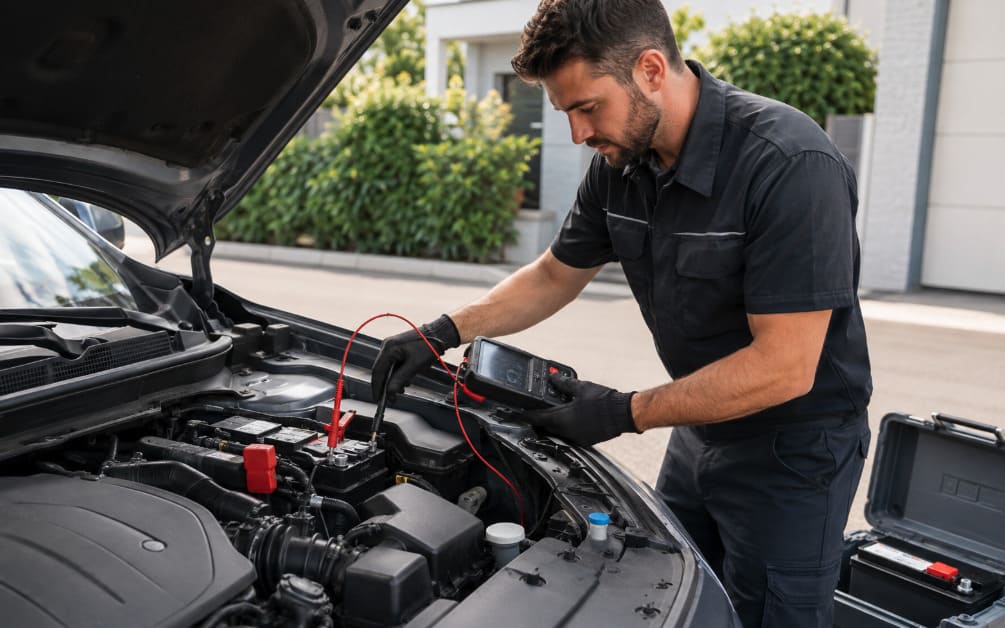
Battery problems can appear in several different ways. The exact symptom helps determine whether testing, charging-system checks, or replacement is the next step.
Slow or weak cranking can occur when the battery cannot provide enough electrical power for normal starting. Battery condition, terminals, cables, and related connections may need to be checked first.
A discharged battery may prevent the engine from cranking and may leave the vehicle with little or no electrical power, but it does not automatically mean the battery itself has permanently failed.
A vehicle that repeatedly needs a jump-start may involve a weak battery, charging-system problem, alternator concern, poor battery connections, or another electrical condition.
Dim lights, weak accessories, or unusual electrical behavior may occur when available battery voltage is low, but charging-system or connection problems can create similar symptoms.
If the battery repeatedly becomes discharged after being charged or jump-started, the battery may no longer hold sufficient charge or another vehicle condition may be draining or failing to recharge it.
If previous testing has confirmed that the battery needs replacement, the next step is confirming battery compatibility, access, and the replacement requirements for the vehicle.
The exact evaluation depends on the vehicle and reported symptoms. The goal is to determine whether the battery actually needs replacement or whether another starting or charging-system problem is responsible.
A dead battery or no-start symptom does not automatically mean a new battery is needed. Loose terminals, corroded connections, charging-system problems, alternator concerns, or another electrical condition can create similar symptoms.
A successful jump-start also does not prove the battery is bad. The battery may be weak, simply discharged, or not being recharged correctly.
If the battery warning light is on, the battery repeatedly loses charge, or a newer battery keeps dying, see Alternator Testing and Charging System Service. If the vehicle will not start and the failed component is unknown, see Car Won’t Start.
The service follows the starting and battery symptoms before replacement is selected.
Provide the vehicle year, make, model, service location, and whether the engine cranks slowly, the battery is completely dead, a jump-start changes the symptom, the battery repeatedly loses charge, or the battery has already been tested.
Battery condition, terminals, cable connections, available voltage, starting behavior, and charging-system performance may be checked based on the symptoms and test results.
The findings help determine whether the next step is battery replacement, terminal or connection service, alternator or charging-system testing, starting-system diagnosis, additional electrical testing, or another repair.
Possible signs include slow cranking, difficulty starting, dim electrical power, repeated need for jump-starts, or a battery that repeatedly becomes discharged. These symptoms can also have other causes, so testing may be helpful.
No. A battery may simply be discharged. Testing can help determine whether it can still hold and deliver enough power or whether replacement is needed.
Not necessarily. A jump-start may help a discharged or weak battery start the vehicle, but charging-system problems or poor electrical connections can also cause a dead-battery condition.
A newer battery that repeatedly becomes discharged may point to an alternator, charging-system, wiring, connection, or other electrical problem.
Battery replacement can often be completed where the vehicle is parked when the battery can be accessed and replaced there.
Some vehicles require additional access, programming, reset procedures, or shop-level equipment for battery replacement.
Use these pages to review the broader service catalog, local service coverage, and common questions before booking battery service.
Browse battery, starting, charging-system, diagnostics, maintenance, and other supported mobile mechanic services.
Review the current Mobile Mechanic Pro service-area directory and supported Hampton Roads city pages.
See how mobile mechanic service works at homes, workplaces, apartments, parking areas, and other vehicle locations.
Find answers about diagnostics, appointments, vehicle locations, and common on-site repair questions.
See examples of mobile mechanic service work and vehicle repair activity.
Use the contact page for general questions that are not part of a vehicle service request.
Slow crank, dead battery, or tired of needing another jump-start? Provide the vehicle details, service location, whether the vehicle currently starts, whether the engine cranks slowly, whether a jump-start changes the symptom, whether the battery repeatedly loses charge, whether the battery warning light is on, and whether the battery has already been tested or recently replaced.