
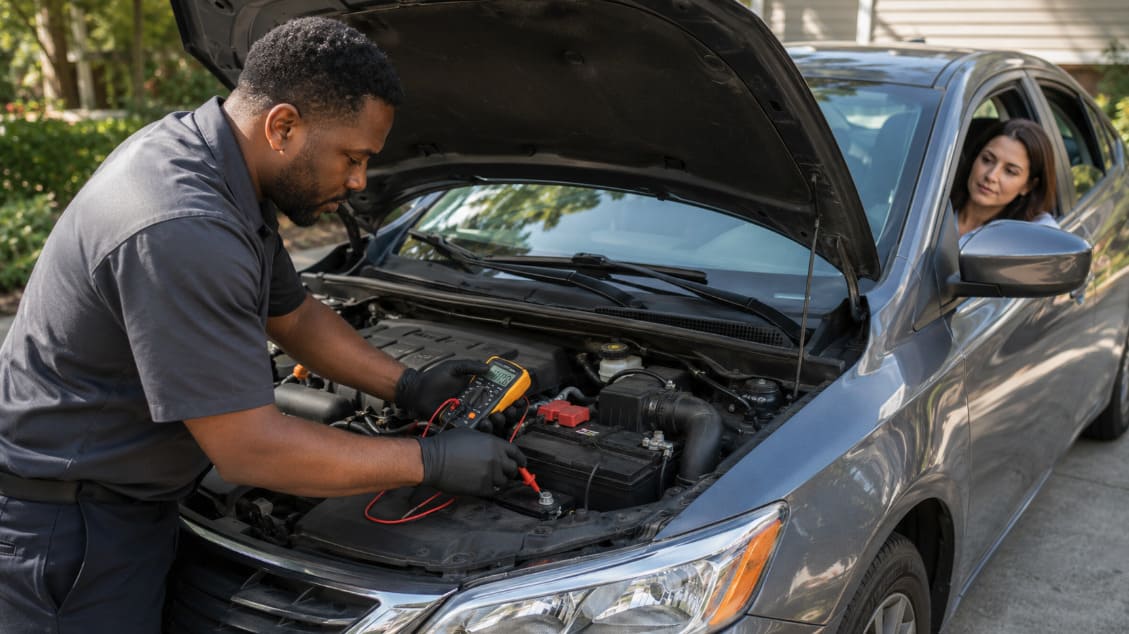
Battery vs starter vs alternator problems can be difficult to separate because all three systems work together during starting and normal vehicle operation. A weak battery can make the starter appear faulty, while a charging problem can eventually leave the battery without enough power to start the engine.
The battery supplies electrical power for starting, the starter uses that power to turn the engine, and the alternator helps recharge the battery and supply electrical power while the engine is running.
When comparing battery vs starter vs alternator symptoms, the timing of the problem is one of the most useful clues. What happens before the engine cranks, during the start attempt, and after the engine begins running can help narrow the diagnostic path.
Battery vs Starter vs Alternator: What Is the Difference?
The simplest way to understand battery vs starter vs alternator problems is to look at the job each component performs and when its symptoms usually become noticeable.
| Component | Main Job | When a Problem May Become Noticeable |
|---|---|---|
| Battery | Stores electrical energy and supplies starting power | Before or during the start attempt |
| Starter | Uses battery power to turn the engine | Primarily during the start attempt |
| Alternator | Produces electrical power and helps recharge the battery while the engine runs | Primarily after the engine starts or after previous driving |
These systems are connected, so symptoms can overlap.
A weak battery can make a healthy starter appear faulty. A charging problem can eventually leave the battery too discharged to start the vehicle. Poor electrical connections can also create symptoms that resemble battery, starter, or alternator problems.
Because battery vs starter vs alternator symptoms can overlap, one starting symptom should not be treated as proof that a particular component has failed.
7 Battery vs Starter vs Alternator Warning Signs to Compare
When trying to distinguish battery vs starter vs alternator trouble, these seven symptom patterns can provide useful clues:
- Rapid clicking during starting can make battery power or connections worth checking.
- One solid click with no normal cranking can make the starter or starting circuit more relevant.
- Slow engine cranking can involve battery power, connections, or the starter.
- Lights working but no engine cranking can involve the battery, connections, starter, or another part of the starting circuit.
- A battery that repeatedly loses charge can make both battery condition and charging-system performance worth investigating.
- Electrical problems while the engine is running can make the alternator or charging system more relevant.
- Normal cranking without the engine starting usually shifts diagnosis beyond the basic battery, starter, and alternator comparison.
A battery vs starter vs alternator comparison is most useful when clicking, cranking speed, battery charge, and electrical behavior are considered together.
These warning signs help organize the diagnostic process, but they do not confirm which component needs repair or replacement.
What Does the Battery Do?
The battery stores electrical energy that the vehicle can use when the engine is not running.
One of its most demanding jobs occurs during starting. The starter motor requires much more electrical current than dashboard lights, interior lights, or many accessories.
That is why a vehicle can sometimes have working lights but still lack enough battery power to crank the engine normally.
Possible Signs Battery Power May Be Involved
Battery condition or electrical supply may deserve attention when symptoms include:
- Rapid clicking during a start attempt
- Slow or labored cranking
- Dashboard lights that dim significantly while starting
- A vehicle that recently required a jump
- Starting problems that appear after the vehicle sits
- Repeated low-battery symptoms
These signs do not automatically prove that the battery itself needs replacement. Battery connections, charging history, and other electrical issues can create similar symptoms.
In a battery vs starter vs alternator comparison, battery trouble often becomes most noticeable before or during the start attempt.
For a deeper look at battery-specific clues, see Signs Your Car Battery Needs Replacing.
Drivers looking for service information can also review the battery service.
What Does the Starter Do?
The starter uses electrical power from the battery to physically turn the engine when the driver turns the key or presses the start button.
If the engine is turning over, the starter is performing at least part of its basic function.
When the starter or starting circuit does not operate normally, the driver may hear a click, experience intermittent starting, or get no engine movement at all.
Possible Signs the Starter or Starting Circuit May Be Involved
Possible symptoms include:
- One solid click without normal cranking
- Intermittent no-crank conditions
- No engine movement despite electrical power being present
- Starting behavior that changes from one attempt to another
However, similar symptoms can occur when battery voltage is inadequate or electrical connections are poor.
A clicking sound alone is therefore not enough to confirm starter failure.
For a closer look at starter-specific warning signs, see bad starter symptoms.
When evaluating battery vs starter vs alternator symptoms, a no-crank condition during the start attempt can make the starter more relevant, but battery power and connections still need to be considered.
The guide on clicking noise when starting a car explains that symptom in more detail.
Additional information about starter service is available when starter involvement is suspected.
What Does the Alternator Do?
The alternator produces electrical power while the engine is running.
Its job includes supplying electricity to vehicle systems and helping restore charge to the battery after starting.
Because the alternator normally works while the engine is running, its symptoms can differ from a basic battery or starter problem.
Possible Signs a Charging-System Problem May Be Involved
Depending on the vehicle and the underlying condition, possible clues can include:
- A battery or charging-system warning light
- Electrical systems behaving unusually while the engine is running
- A battery that repeatedly becomes discharged
- A vehicle that starts after receiving additional battery power but later develops electrical problems again
- The engine stopping after a significant charging-system problem develops
These symptoms can have other causes, so testing is still important.
For a closer look at charging-system warning signs, see signs of a bad alternator.
The difference between battery vs starter vs alternator trouble can become clearer when symptoms during starting are compared with electrical symptoms that appear after the engine is running.
For service information related to charging-system symptoms, review the alternator service.
Is It the Battery, Starter, or Alternator? Start With the Symptoms
Instead of guessing which part failed, compare what the vehicle actually does. This is often the most useful way to approach a battery vs starter vs alternator question.
The Dashboard Lights Are Weak or Do Not Come On Normally
Battery charge, battery connections, or another electrical-supply issue may deserve attention.
That does not automatically identify the battery as the failed component, but electrical supply becomes an important part of the diagnostic process.
The Lights Work but the Car Will Not Start
Working dashboard lights do not rule out a weak battery.
The lights require far less electrical current than the starter motor, so the battery may still illuminate the dashboard without having enough available power to crank the engine normally.
The related article Car Won’t Start But Lights Come On: What It Can Mean covers that situation in greater detail.
The Car Makes Rapid Clicking Sounds
Rapid repeated clicking can be associated with insufficient electrical power or poor electrical connections.
Battery condition and connections may deserve attention before assuming the starter itself is responsible.
The Car Makes One Solid Click
A single click with no normal cranking may shift attention toward the starter, starter circuit, electrical supply, or related connections.
It does not automatically confirm that the starter needs replacement.
The Engine Cranks Slowly
Slow cranking often makes battery power and electrical supply worth investigating.
The starter can also be part of the diagnostic process, which is why testing is more reliable than replacing a part based on the symptom alone.
The Engine Cranks Normally but Does Not Start
If the engine turns over at a normal speed, the problem may be outside the basic battery-versus-starter question.
The diagnostic process may need to consider fuel delivery, ignition, sensors, engine-management systems, or another mechanical or electrical condition.
For broader problems where the cause is unclear, review the vehicle diagnostic service.
Battery vs Starter vs Alternator Symptom Comparison
This battery vs starter vs alternator comparison can help organize the most common symptom patterns.
| Symptom | Battery or Connections | Starter | Alternator / Charging System |
|---|---|---|---|
| Rapid clicking | Often worth checking | Possible | Usually indirect |
| Slow cranking | Often worth checking | Possible | Possible if battery was not being recharged |
| One solid click | Possible | Often worth checking | Less typical as the immediate cause |
| Lights work but no crank | Possible | Possible | Usually indirect |
| Starts with additional battery power | Possible | Less strongly suggested by this clue alone | Charging system may still need evaluation |
| Battery repeatedly becomes discharged | Possible | Less typical | Charging system may need evaluation |
| Electrical problems while engine is running | Possible | Less typical | Charging system may deserve attention |
| Normal crank but no start | Less typical as the primary clue | Less typical | Usually requires broader diagnosis |
These patterns are diagnostic clues rather than guarantees. Several faults can create similar symptoms, and more than one issue can sometimes be present.
Comparing battery vs starter vs alternator symptoms side by side can help identify which system deserves attention first without treating the comparison as a confirmed diagnosis.
Can a Bad Alternator Cause a Car Not to Start?
Yes, but usually indirectly. The battery supplies the electrical power used during the immediate start attempt, while the alternator normally works after the engine begins running.
If the alternator was not adequately recharging the battery while the vehicle was running, the battery may eventually become too discharged to start the engine.
The immediate symptom can therefore look like a battery problem even though the charging system contributed to the battery losing charge.
In a battery vs starter vs alternator diagnosis, repeated battery discharge combined with electrical symptoms while the engine is running can make charging-system testing especially relevant.
This is one reason battery and charging-system testing may need to be considered together.
Can a Bad Battery Make the Starter Seem Bad?
Yes. If the battery cannot provide adequate current, the starter may click, turn slowly, or fail to crank the engine.
Those symptoms can resemble a starter problem even when the starter itself is not the original cause.
The opposite can also occur. Adequate battery power cannot compensate for a starter or starting-circuit fault.
Testing helps separate these possibilities when comparing battery vs starter vs alternator symptoms.
Can a Bad Starter Drain the Battery?
Repeated attempts to start a vehicle can consume battery power regardless of the original cause of the no-start condition.
However, a battery that repeatedly becomes discharged while the vehicle is simply parked points toward a different diagnostic question than a starter that fails during a start attempt.
If the vehicle develops problems after sitting unused, see Why Your Car Won’t Start After Sitting.
Will a Jump Start Tell You Whether the Battery, Starter, or Alternator Is Bad?
No. A jump start can provide a useful clue, but it does not provide a complete battery vs starter vs alternator diagnosis.
If additional battery power allows the vehicle to crank and start, battery charge or electrical supply may deserve closer attention.
When a jump start changes the vehicle’s behavior, that result can provide another clue in a battery vs starter vs alternator diagnosis, but it should not be treated as proof that a specific component has failed.
A successful jump does not automatically prove:
- The battery itself is bad
- The alternator is good
- The charging system is operating normally
- The problem will not return
Likewise, a vehicle that still will not start after receiving additional battery power may have a starter problem, an electrical issue, or another no-start condition.
The vehicle’s response is one part of the diagnostic picture.
Why Testing Matters Before Replacing Parts
Testing matters because battery vs starter vs alternator symptoms overlap enough that replacing a component based only on a guess can lead to unnecessary repairs.
Testing can help resolve a battery vs starter vs alternator question before a part is replaced based only on starting or charging symptoms.
A diagnostic process may consider:
- Battery condition
- Battery voltage and performance under load
- Battery and electrical connections
- Starting-system operation
- Starter electrical supply
- Charging-system performance
- Vehicle behavior while running
- Other systems if the engine cranks but does not start
The exact testing procedure varies by vehicle and symptom.
The important point is that a symptom can identify where diagnosis should begin without proving which part needs replacement.
The Federal Trade Commission’s Auto Repair Basics guide also explains that loose or poor connections can make battery, starter, or alternator problems appear to be component failures, which reinforces the value of checking connections and testing before replacement.
What Should You Notice Before Requesting Diagnosis?
Drivers do not need to identify the failed component themselves.
A few observations can help describe the problem more accurately:
- Do the dashboard lights come on normally?
- Does the engine crank?
- Is the cranking speed normal or slow?
- Do you hear rapid clicking or one solid click?
- Do the lights dim significantly during the start attempt?
- Did the vehicle recently need a jump?
- Does the battery repeatedly lose charge?
- Does the problem happen only after the car sits?
- Does the vehicle start and then develop electrical problems while running?
These details can help separate battery, starter, charging-system, and broader no-start symptoms.
For Hampton Roads drivers, identifying a battery vs starter vs alternator problem can help determine whether the next step should focus on starting power, the starter circuit, charging-system performance, or broader diagnosis.
If there is smoke, a burning smell, visible electrical damage, damaged battery components, or another obvious safety concern, stop attempting to start the vehicle and have the condition evaluated.
When Does a Battery vs Starter vs Alternator Problem Need Diagnosis?
A battery vs starter vs alternator diagnosis becomes especially useful when several possible causes fit the same symptoms or when a temporary solution does not prevent the problem from returning.
Repeated no-start problems are another reason a battery vs starter vs alternator diagnosis may be more useful than guessing from one symptom.
Professional evaluation may make sense when:
- The vehicle repeatedly fails to start
- Battery problems keep returning
- The car clicks but does not crank
- The engine cranks slowly
- It is unclear whether battery power or the starter is responsible
- Charging-system symptoms appear while the engine is running
- A temporary jump does not prevent the problem from returning
- Parts would otherwise be replaced based on guesswork
For Hampton Roads drivers, Mobile Mechanic Pro coordinates service requests with independent mobile mechanics who can evaluate applicable vehicle problems on-site.
If the vehicle will not start, review the no-start service. When the cause is less clear, the vehicle diagnostic service provides another appropriate next step.
Frequently Asked Questions About Battery vs Starter vs Alternator Problems
How can I tell if it is the battery or starter?
Battery problems are often associated with rapid clicking, slow cranking, or weak electrical power. A starter or starting-circuit problem may become more relevant when electrical power appears present but the engine does not crank. Because symptoms overlap, testing is the more reliable way to distinguish them.
How can I tell if the battery or alternator is the problem?
A battery problem often becomes noticeable during starting, while charging-system problems may appear after the engine is running or as a battery that repeatedly loses charge. Testing battery condition and charging-system performance may be necessary.
Does one click mean the starter is bad?
No. A single click can make the starter or starter circuit worth checking, but battery power, electrical connections, and other starting-system problems can create similar symptoms.
Can the alternator be bad if the car still starts?
Yes. A vehicle may still start while a charging-system problem is developing if the battery still contains enough charge. What happens while the engine is running and whether the battery remains charged provide additional clues.
What is the best way to compare battery vs starter vs alternator symptoms?
The best approach to a battery vs starter vs alternator comparison is to look at when the problem occurs, how the engine cranks, whether clicking is present, whether electrical symptoms appear while the engine is running, and whether the battery repeatedly loses charge. Testing is usually more reliable than identifying the failed part from one symptom alone.
Should I replace the battery first if the car will not start?
Not automatically. A weak battery is one possible cause, but starter, electrical, charging, and other no-start problems can produce overlapping symptoms. Testing can help avoid replacing a part that is not responsible.