
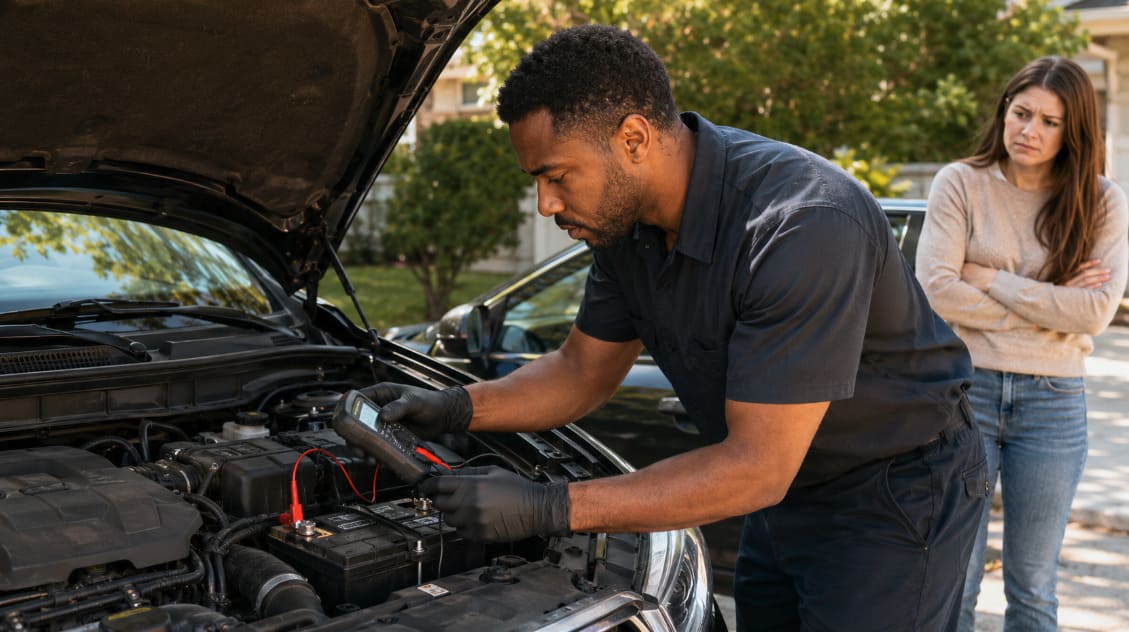
Signs your car battery needs replacing can include slow engine cranking, rapid clicking, repeated jump starts, dimming lights during starting, or a battery that repeatedly loses charge. These warning signs can make battery condition worth testing, but they do not automatically prove that the battery needs replacement.
Poor electrical connections, starter problems, charging-system issues, and other electrical conditions can produce similar symptoms. The goal is to recognize the clues, understand what they may mean, and determine when battery testing makes sense before replacing a part based on a guess.
This guide covers eight common signs your car battery needs replacing, how battery problems can overlap with starter and alternator symptoms, and when testing may be the better next step.
8 Signs Your Car Battery Needs Replacing
The most common signs your car battery needs replacing involve changes in starting performance or a battery that cannot maintain adequate charge. Warning signs can include:
- Slow or labored engine cranking
- Rapid clicking when trying to start
- Dashboard lights that dim significantly during starting
- Repeatedly needing a jump start
- Starting problems after the vehicle sits
- Intermittent no-start problems
- Electrical behavior that changes during starting
- A battery that repeatedly loses charge
These signs your car battery needs replacing are most useful when considered together with how the vehicle behaves during a start attempt. One symptom alone may not identify the cause.
Several signs your car battery needs replacing occurring together can provide a stronger reason to test the battery, connections, and related starting or charging systems.
1. Slow Engine Cranking Can Be a Battery Warning Sign
Slow or labored cranking can make battery condition worth checking because the starter requires substantial electrical power to turn the engine.
If the battery cannot provide enough power, the engine may turn over more slowly than normal during the start attempt.
Among the signs your car battery needs replacing, repeated slow cranking is useful to notice because it can indicate that electrical supply during starting deserves testing.
What Does Slow Cranking Sound Like?
Slow cranking usually sounds noticeably weaker or more labored than the vehicle’s normal starting sound.
However, slow cranking does not confirm that the battery itself is responsible. Electrical connections and the starter can also affect cranking speed.
2. Rapid Clicking When Starting May Point Toward Low Battery Power
Rapid clicking can occur when the starting system does not have enough electrical power to operate normally.
The battery may still provide enough power for dashboard or interior lights while being unable to supply the much greater current required during engine cranking.
Rapid clicking is one of the signs your car battery needs replacing that can overlap strongly with poor connections and other starting-system problems, so the sound should be treated as a clue rather than a diagnosis.
If clicking is the main symptom, see clicking noise when starting a car for a closer look at rapid clicking, a single click, and related no-start symptoms.
3. The Lights Work but the Car Still Will Not Start
Working dashboard lights do not rule out a weak battery because lights require much less electrical current than the starter motor.
A battery may still illuminate the dashboard, headlights, or interior lights while being unable to crank the engine normally.
When working lights appear alongside other signs your car battery needs replacing, battery condition, electrical connections, and the starting system may all deserve further evaluation.
If this is the main symptom, see car won’t start but lights come on.
4. Repeated Jump Starts Can Be a Sign the Battery Needs Testing
Repeatedly needing a jump start can make battery condition worth testing, but a successful jump does not automatically prove that the battery needs replacement.
The underlying issue could involve:
- A battery that is no longer holding adequate charge
- A charging-system problem
- An electrical draw while the vehicle is parked
- Poor electrical connections
- Another starting-system condition
A jump start is better treated as a diagnostic clue than a final answer.
Repeated jump starts can be among the more noticeable signs your car battery needs replacing, especially when the problem keeps returning, but testing is still useful for determining why adequate charge is not available.
5. Starting Problems After the Car Sits Can Point Toward Battery Condition
A battery problem can become more noticeable after the vehicle has been parked for a period of time.
A battery that still starts the vehicle during frequent use may struggle after sitting if its condition has deteriorated or another electrical problem is reducing its charge.
Other possible causes include an abnormal electrical draw or a charging issue that left the battery with less stored energy before the vehicle was parked.
Starting trouble after sitting can appear alongside other signs your car battery needs replacing, but the amount of time the vehicle was parked does not identify the failed component by itself.
See why a car won’t start after sitting for a more detailed explanation of that situation.
6. Dashboard Lights Dim Significantly During Starting
Significant dimming during a start attempt can make battery power or electrical supply worth investigating, but it does not prove that the battery has failed.
The starter draws substantial current while cranking the engine. If available electrical power is limited, dashboard or interior lights may become noticeably dimmer during that moment.
Dimming lights may be one of the signs your car battery needs replacing, but battery connections, electrical resistance, and other starting-system problems can create similar behavior.
7. The Battery Repeatedly Loses Charge
A battery that repeatedly becomes discharged deserves further investigation because the battery itself is not the only possible cause.
Repeated loss of charge can involve battery condition, the charging system, an electrical draw while parked, or another electrical problem.
Among the signs your car battery needs replacing, repeated loss of charge is important to investigate because replacing the battery without determining why it keeps becoming discharged may leave the underlying problem unresolved.
8. A Battery or Charging Warning Light Appears
A battery-shaped warning light does not necessarily mean the battery itself needs replacement.
The warning is commonly associated with the vehicle’s charging system. If it appears while the engine is running, the issue may involve the alternator, charging circuit, wiring, or another electrical condition – signs of a bad alternator.
A warning light can appear alongside signs your car battery needs replacing, but charging-system performance should also be considered before battery replacement is assumed.
Does a Battery Warning Light Mean the Battery Needs Replacing?
No. A battery warning light can indicate a charging-system problem rather than a failed battery.
Replacing the battery simply because the warning light appears could leave the actual cause unresolved.
The warning should be considered alongside other signs your car battery needs replacing, starting behavior, and charging-system symptoms.
Battery vs. Starter vs. Alternator: Which One Is Causing the Problem?
Battery, starter, and alternator problems can produce overlapping symptoms. Comparing how the vehicle behaves can help guide testing without proving which component has failed.
| Symptom | Battery or Connections | Starter | Alternator or Charging System |
|---|---|---|---|
| Rapid clicking | Often worth checking | Possible | Usually indirect |
| Slow cranking | Often worth checking | Possible | Possible if battery charge is not being restored |
| One solid click | Possible | Often worth checking | Less typical |
| Repeated jump starts | Often worth checking | Less typical | Charging system may need evaluation |
| Battery repeatedly loses charge | Yes | Less typical | Yes |
| Electrical problems while driving | Possible | Less typical | Charging system may deserve attention |
| Normal cranking but no start | Less typical as the main clue | Less typical | Usually requires broader diagnosis |
These patterns are diagnostic clues rather than definite answers.
Comparing the signs your car battery needs replacing with starter and charging-system symptoms can help narrow the diagnostic path, but testing remains more reliable than guessing which part is responsible.
For the broader comparison, see the battery vs. starter vs. alternator guide.
How Can a Bad Alternator Look Like a Battery Problem?
A charging-system problem can eventually leave the battery without enough stored power to start the vehicle.
The battery supplies the initial power needed for starting. Once the engine is running, the alternator helps provide electrical power and restore charge to the battery.
If the charging system is not operating normally, the vehicle may eventually present what appears to be a weak or discharged battery.
This means apparent signs your car battery needs replacing can sometimes originate with the charging system rather than the battery itself.
For more information about charging-system service, review the alternator service.
Can a Starter Problem Look Like a Weak Battery?
Yes. A starter or starting-circuit problem can sometimes produce symptoms that resemble weak battery power.
Clicking, failure to crank, and other starting symptoms can overlap. Likewise, a weak battery can prevent a functioning starter from operating normally.
That is why signs your car battery needs replacing should be considered together with starter behavior rather than assuming that a particular part needs replacement.
The battery vs. starter vs. alternator guide explains the broader differences.
Does a Battery Need Replacing Just Because the Car Needed a Jump?
No. One jump-start event does not automatically mean the battery needs replacement.
The battery may have become discharged because:
- The vehicle was left unused
- An electrical load drained the battery
- The charging system did not restore enough charge
- A light or accessory remained on
- The battery itself is no longer performing normally
The reason the battery became discharged matters.
A jump can be one of the signs your car battery needs replacing, but a repeated pattern is more informative than a single event. Testing can help determine whether battery replacement is appropriate or whether another electrical problem deserves attention.
When Should a Car Battery Be Tested?
Battery testing becomes useful when starting symptoms repeat, several battery-related warning signs appear together, or it is unclear whether the battery or another system is responsible.
When several signs your car battery needs replacing appear together or keep returning, testing can help separate battery condition from starter, charging-system, and connection problems.
Testing may make sense when:
- The engine consistently cranks slowly
- Rapid clicking occurs during starting
- The vehicle repeatedly needs a jump
- Starting becomes unreliable after the vehicle sits
- The battery repeatedly loses charge
- Battery condition versus starter condition is unclear
- A charging-system problem may be involved
Testing helps separate battery condition from other problems that can create similar symptoms.
Loose or corroded battery terminals can also make a battery appear dead or defective. The Federal Trade Commission’s Auto Repair Basics guidance recommends checking connections and testing battery function before replacement is assumed.
What Should Drivers Notice Before Requesting Battery Service?
Drivers do not need to determine whether the battery has failed before requesting service. Describing the vehicle’s behavior is usually more useful.
Useful observations include:
- Whether the engine cranks
- Whether cranking is fast, normal, or slow
- Whether the vehicle produces rapid clicking or one click
- Whether dashboard lights dim significantly
- Whether the vehicle recently needed a jump
- Whether the problem occurs after sitting
- Whether the battery repeatedly loses charge
- Whether a battery or charging warning light appears
- Whether unusual electrical symptoms occur while the engine is running
These details can help put signs your car battery needs replacing into context and identify which part of the starting or charging system deserves testing.
If the battery is visibly damaged, leaking, excessively swollen, smoking, unusually hot, or associated with a strong burning odor, avoid handling it and have the condition evaluated.
When Might Battery Replacement Be Appropriate?
Battery replacement may be appropriate when testing shows that the battery can no longer perform as required.
Even when several signs your car battery needs replacing are present, testing is useful before assuming replacement is necessary.
A vehicle with slow cranking or repeated no-start problems might have a weak battery, but the actual cause could also involve connections, the charging system, the starter, or another electrical issue.
Confirming battery condition before replacement can help avoid unnecessary parts replacement.
For additional service information, review the battery service.
When Do Signs Your Car Battery Needs Replacing Need Diagnosis?
Signs your car battery needs replacing may warrant diagnosis when the vehicle cannot be started reliably, the battery repeatedly loses charge, or the same symptoms could involve more than one electrical system.
Repeated signs your car battery needs replacing can make testing especially useful when battery condition, electrical connections, the starter, and the charging system could all fit the symptoms.
Diagnosis may be useful when:
- The car repeatedly fails to start
- The battery keeps losing charge
- Jump starts provide only temporary results
- The car clicks but will not crank
- Battery versus starter symptoms are unclear
- A charging-system issue may also be involved
- The vehicle cannot easily be moved for diagnosis
For Hampton Roads drivers, a vehicle that cannot be started reliably can be difficult to move. When access, working conditions, and the vehicle allow, an on-site vehicle diagnostic service may provide an appropriate next step.
When the concern is specifically battery-related, review the battery service.
Frequently Asked Questions About Signs Your Car Battery Needs Replacing
What are the most common signs your car battery needs replacing?
Common signs your car battery needs replacing can include slow cranking, rapid clicking, recurring jump starts, dimming lights during starting, starting problems after the vehicle sits, and a battery that repeatedly loses charge. These symptoms can also have other causes, so testing may still be needed.
Can a bad battery still have enough power for the lights?
Yes. Lights and accessories require much less electrical current than the starter, so a weak battery may illuminate the dashboard while still being unable to crank the engine normally.
Does needing a jump mean the battery needs replacement?
Not necessarily. A jump can indicate low battery charge, but the reason for that low charge could involve the battery, charging system, an electrical draw, poor connections, or another condition.
How can battery and starter problems be distinguished?
Battery problems often produce clues such as slow cranking or rapid clicking, while a starter problem may produce one solid click or failure to crank despite electrical power being present. Because the symptoms overlap, testing is more reliable than identifying the failed component from one symptom.
Can an alternator problem drain the battery?
A charging-system problem can leave the battery without enough charge over time. If a battery repeatedly becomes discharged, both battery condition and charging-system performance may need to be considered.